Is ReelShort Legit? What the 4.7★ App Store Score and 1.3★ Trustpilot Score Really Mean
- Yes, the app is legitimate. It is published by New Leaf Publishing and is one of the largest short-drama apps worldwide — 100M+ downloads on Google Play alone.
- We checked three independent sources in October 2026: App Store 4.7★ (506K ratings), Google Play 3.8★ (1.92M reviews), Trustpilot 1.3★ (265 reviews).
- The gap is not a contradiction: store ratings are prompted in-app after an episode; Trustpilot reviews are written by people with a billing problem.
- Trustpilot's dominant complaint theme is payment — repeated charges and difficult cancellations. Its profile is unclaimed, so the company does not respond there.
- The real risk with apps like this is subscription renewal and cancellation friction, not fraud.
- One more thing we verified on 10 October 2026: the same Weekly VIP plan cost $11.87 for the first week on the publisher web checkout versus $1.99–$5.99 on Play billing in our earlier captures. The checkout you land on changes the price — and web subscriptions sit outside the store management tools.
The short answer
Yes, it is legitimate. It is published by New Leaf Publishing, it has tens of millions of users, and payments run through the normal app store billing systems.
But “legitimate” and “safe to hand your card to without thinking” are different claims, and the second one deserves a proper answer. The complaints that surround this app are almost entirely about subscription renewal and cancellation friction — not about it being fake.
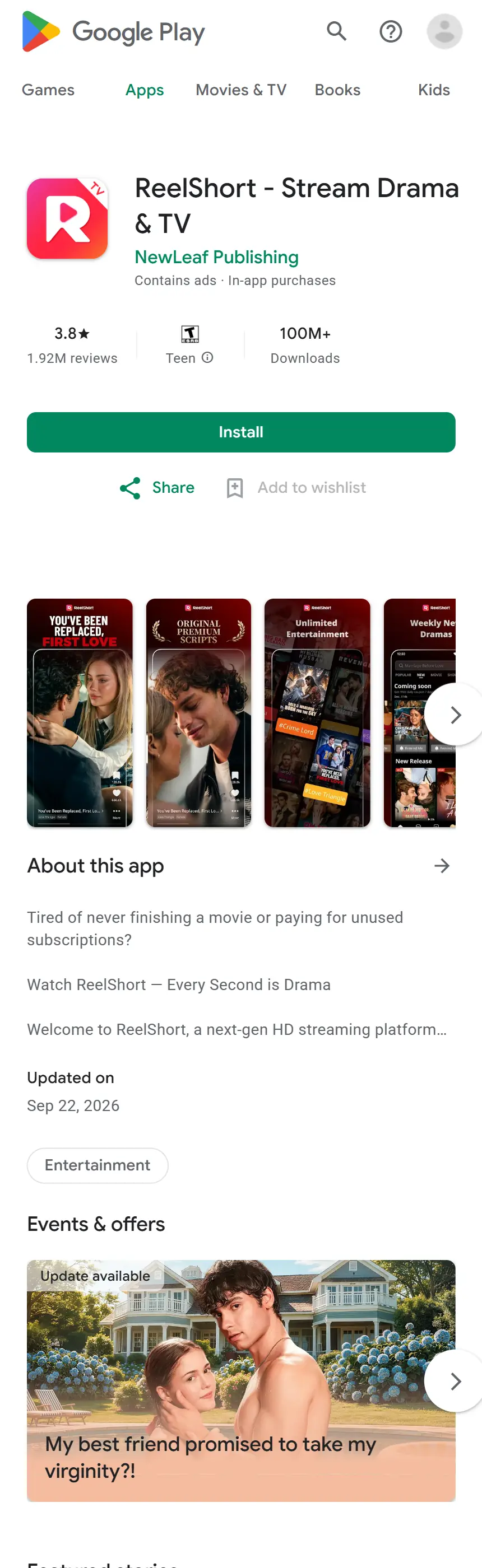
Why the three scores disagree so violently
This is the most useful thing on this page, so it is worth slowing down for. We pulled the app’s standing from three independent sources in October 2026:
| Source | Score | Sample | What it measures |
|---|---|---|---|
| Apple App Store (US) | 4.7 / 5 | 506K ratings | “Was that story good?” |
| Google Play | 3.8 / 5 | 1.92M reviews | A mix of content and billing gripes |
| Trustpilot | 1.3 / 5 (Bad) | 265 reviews | “Did billing treat me well?” |
That spread — nearly five stars on one platform, barely one on another — is not evidence of a cover-up. It is evidence that each platform collects answers to a different question from a different population.
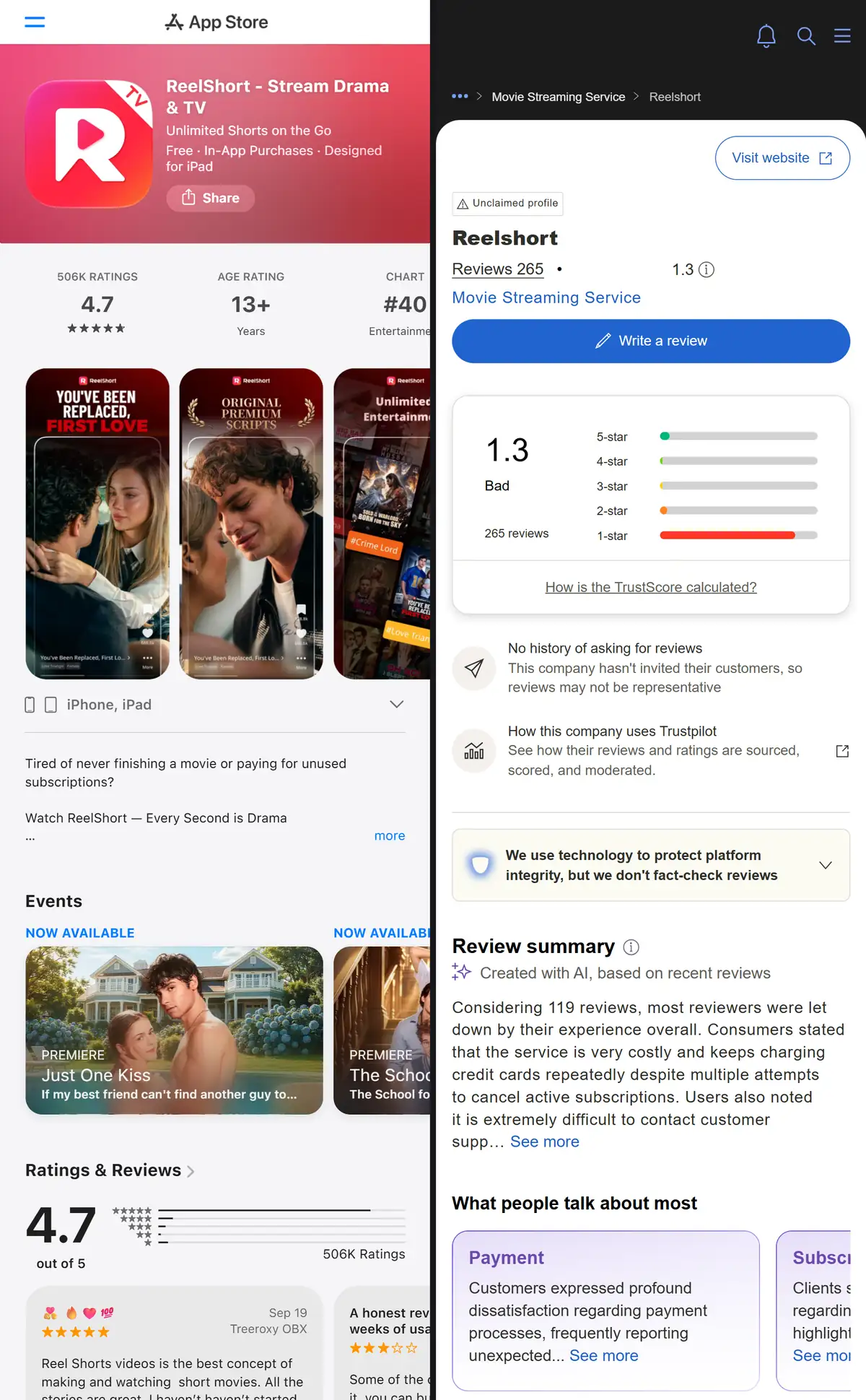
App store ratings are usually prompted inside the app, often right after an episode ends. So they measure “was that story good?” Trustpilot-style reviews are written unprompted, and the overwhelming trigger for writing one is a problem with money. Trustpilot’s own topic summary for this app puts Payment first, with recurring complaints about repeated charges and cancelled subscriptions that kept billing. Nobody opens a review site to say a drama was fun.
Both numbers are therefore “true” and neither is a complete picture. A high app store score with a low billing review score describes a product people enjoy that is sold in an annoying way. That is a legitimate thing to be warned about — and it is a pricing-model criticism, not a fraud accusation.
One more detail that matters when reading those Trustpilot reviews: the profile is unclaimed, meaning the publisher has not taken it over and does not respond there. Silence on Trustpilot is normal for app publishers — it does not confirm the complaints, but it means you should not expect a public rebuttal either. Judge both sides yourself.
Who publishes it, and why that matters
The app comes from an established studio that pioneered the English-language vertical drama format — the model where each episode runs a minute or two and every episode ends on a cliffhanger. On Google Play it appears as New Leaf Publishing, with 100M+ installs and a catalogue updated weekly. It is one of the largest operators in the category by user numbers and reported revenue.
Practical significance: this is not an anonymous app that might vanish with your subscription. It is a real business with a catalogue, a support process, and a reputation to protect. The company is not the risk. The billing model is.
The actual risks, ranked
Auto-renewal you did not plan for. The single most common complaint. Weekly tiers renew fast — we documented a plan at $5.99/week after a $1.99 first week — and “I’ll cancel after this series” easily becomes three more weeks of charges.
Cancellation friction. Cancelling has to be done through the store you subscribed on — the app itself usually cannot cancel it for you. People who look in the wrong place conclude it cannot be cancelled.
Coins spent before you notice the total. Paying per episode hides the running total. At 60 coins (about 60 cents) per episode, a series that feels like small purchases adds up to about $30 — more than an annual subscription at some rivals.
Third-party “free coins” sites. Not a risk from the app itself, but the most common way people actually lose money around it. See our free coins guide for what genuinely works.
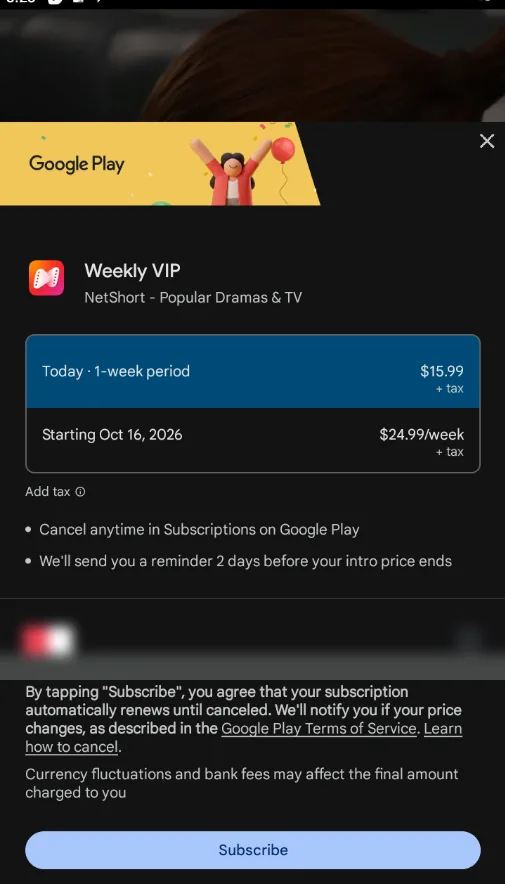
Your card details are not being handled by an unknown party — in-app purchases go through Google Play billing, and the web checkout documented below is a standard payment page. Nobody is going to drain your bank account. The realistic worst case is a few unwanted renewals, which is why the fix is process rather than paranoia.
One more billing detail worth knowing
ReelShort does not bill only through Google Play. It also runs its own web checkout — cards, PayPal and bank transfer, run by the publisher — where the same Weekly VIP plan costs more than the in-app price, and a web subscription sits outside your store’s cancellation tools. That is a big part of why people keep getting billed after they thought they cancelled (our charged-after-cancel guide covers what to do when that happens).
We break down the two checkouts, the rotating intro offers, and how to read the real total in our subscription trap guide — that is the page that owns the full price comparison, so we keep it there instead of repeating it on every guide.
How to protect yourself in five minutes
- Before subscribing: write down the renewal period and the post-intro price. Screenshot the subscription screen.
- Before subscribing: open your app store’s subscription settings and confirm you can see the app listed there. If you can see it, you can cancel it.
- At sign-up: set a calendar reminder two days before the first renewal.
- If you want to stop: cancel through the app store, then re-open the subscription page and confirm the renewal date is gone. Our cancellation walkthrough covers the exact steps.
- If you subscribed on the web checkout: the store subscription list will not show it at all. Cancel from the same place you signed up — the publisher subscription page — and keep the confirmation email.
- If a charge looks wrong: go to the app store’s refund route first — it is faster than contacting the publisher and it is the channel that actually controls the billing.
What this page cannot tell you
- Ratings move. The three scores above were captured on 8 October 2026; by the time you read this they will have drifted. The pattern — high in-app store scores, poor independent billing reviews — has been stable, but check the live numbers yourself.
- We cannot tell you whether you will enjoy it. That is a taste judgement and no review substitutes for the free episodes.
- A legitimacy check is not a quality verdict. This page answers “is it real”, not “is it worth it”. For the second question see the full review.
- We are not affiliated with the publisher. We earn a commission if you sign up through our links, at no extra cost to you. That is disclosed on every page.
Bottom line
It is a real app from a real studio, and the content is why it has tens of millions of users. The thing to be careful about is the same thing you should be careful about in every subscription app: know the renewal terms before you subscribe, and know how to cancel before you need to.
Frequently asked questions
Is ReelShort a scam?
No. It is published by New Leaf Publishing and is among the largest short-drama apps by usage — 100M+ downloads and a 1.92M-review Google Play presence as of October 2026. The complaints attached to it are about subscription renewal and cancellation friction, which is a pricing-model problem rather than a fraud problem.
Why does ReelShort have such a low Trustpilot score?
Because people write a Trustpilot review after something went wrong, typically a charge they did not expect or a cancellation that did not stick. Delighted viewers rate the app inside the app store instead. The two scores are answering different questions — and note the Trustpilot profile is unclaimed, so nobody from the company responds there.
Is it safe to enter card details in ReelShort?
In the app, purchases are processed through Google Play billing, which is the safer arrangement. But we verified on 10 October 2026 that ReelShort also runs its own web checkout that takes cards, PayPal and other methods directly — there you are paying the publisher outside the store. It is a normal payment processor rather than a stranger, but the store subscription-management and refund tools will not cover it. The risk is not card theft — it is an auto-renewing subscription you forget about.
What should I check before subscribing?
Three things: the exact renewal period, the price after any introductory offer ends, and the cancellation steps. Decide how you will cancel before you subscribe, not after the first charge appears.
This guide covers one question about ReelShort. For pricing, the free tier and what it is actually like to use, see our ReelShort full review.