Are Short Drama Apps a Scam? What We Found Testing Six of Them
- No, they are not scams. Six major apps keep their free content free and charge openly through the app stores. They are licensed publishers with real companies behind them, and their in-app purchases go through Apple and Google like any other app.
- The trust problem is real but different: the billing is aggressive. Rotating intro discounts, renewal rates more than half again the introductory price, and automatic charges are techniques that look predatory even when the app is not a scam.
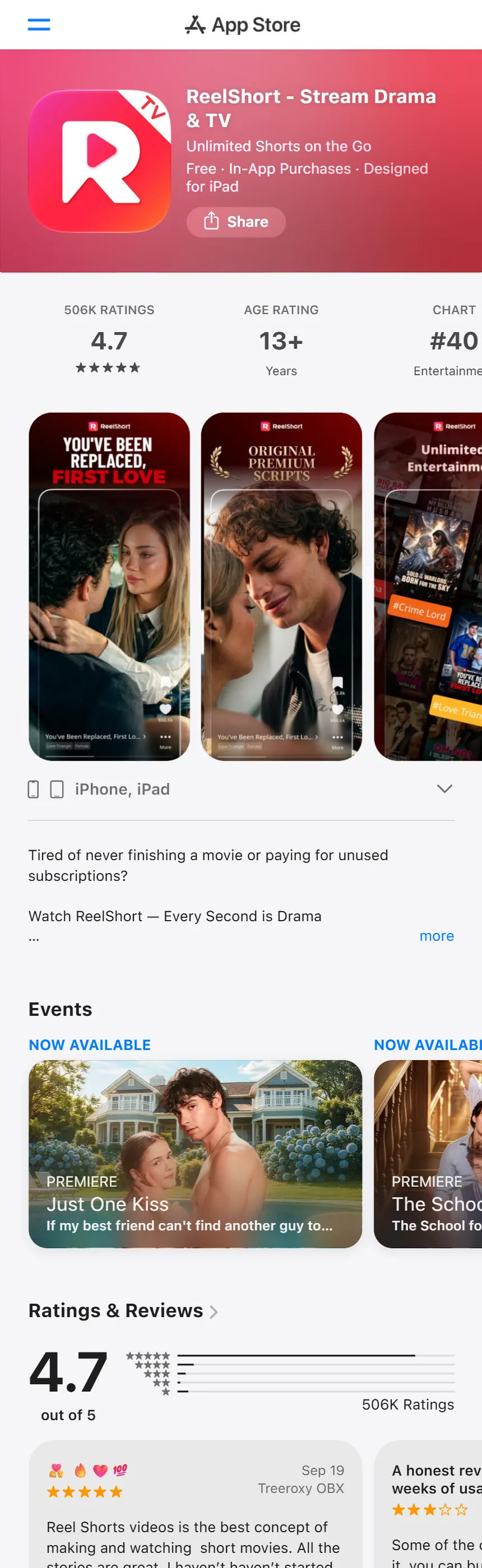
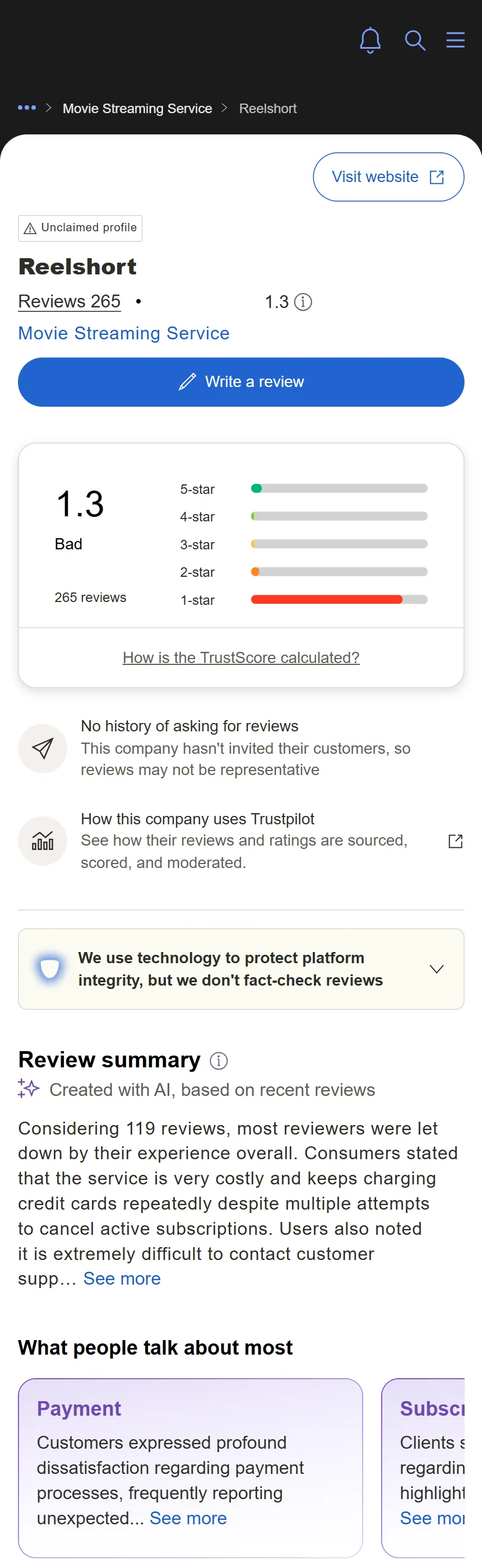
- The clearest evidence: ReelShort scores 4.7 on the App Store and 3.8 on Google Play, but 1.3 on Trustpilot — a 1.3 that comes from 265 reviews complaining almost entirely about billing and cancellation, not about the shows.
- One thing genuinely worth calling out: the Trustpilot profile is unclaimed, meaning the company does not respond to complaints there. That is not fraud, but it is the reason bad experiences go unanswered.
- The practical test: check the store listing and the renewal price before you pay. If a publisher is named, the store shows the exact charge, and the renewal terms are visible, it is a business, not a scam.
The short answer
No. Short drama apps are not scams. That is the finding from testing six of them in-app, and it is worth stating plainly because a lot of the search results on this question are written by people who have not installed anything.
They are licensed publishers with named companies behind them, they sell through the Apple App Store and Google Play, and the free content they promise is genuinely free. What you are actually reacting to when a subscription feels like a scam is a set of billing techniques that look predatory even when nothing illegal has happened.
Those are two different problems, and confusing them is expensive in both directions: if you assume a scam you will keep paying, and if you assume it is fine you will keep paying too. So here is both sides.
What makes these apps legitimate
Legitimacy is not a vibe. It is a set of checkable facts, and all six apps we tested pass them:
A named publisher, not an anonymous listing. ReelShort is published by New Leaf Publishing; DramaBox by Storymatrix; NetShort by Netstory. All of them are identifiable companies with public storefronts.
The payment runs through Apple or Google. This is the single most important fact on this page. When you subscribe, the money goes to the app store, not to an unknown merchant. That means the store’s refund process applies, and Apple or Google can reverse a charge you did not authorise.
The free content is free. Every app installs free and gives away a real block of episodes. No app in this category demands payment before you have seen anything.
The store shows the exact charge. The renewal amount is displayed in the store subscription screen before you confirm, which is where the game this page is about is actually played.
A scam usually needs your card number. On these apps it never gets your card number — Apple or Google handles it. That single fact removes the most common fraud vector in this category, and it is also why the correct response to a bad experience here is a refund request through the store, not a dispute.
The 4.7 versus 1.3 gap, explained
Here is the single most useful piece of evidence on this whole question, and it is the one that settles most of the argument.
ReelShort — the biggest app in the category — carries three ratings at once, and they disagree wildly:
| Where | Rating | Sample | Who is rating |
|---|---|---|---|
| App Store (US) | 4.7 / 5 | 506K ratings | People who chose to install it |
| Google Play | 3.8 / 5 | 1.92M reviews | The same, on Android |
| Trustpilot | 1.3 / 5 (Bad) | 265 reviews | People arriving with a billing complaint |
Read that as three different questions. The App Store rating answers is the content worth installing. The Trustpilot rating answers what happens when I try to get my money back. Both are true, and they are not about the same thing.
When a Trustpilot score sits this far below the store score, the gap is almost always about money rather than product. If the app were failing to deliver the shows, the App Store rating would fall too. It has not.
The App Store numbers across the category cluster tightly, which is what you would expect from a legitimate publishing model:
| App | Developer | Rating | Ratings |
|---|---|---|---|
| GoodShort | Singapore New Reading | 4.90 | 529K |
| DramaBox | Storymatrix | 4.75 | 872K |
| NetShort | Netstory | 4.74 | 219K |
| ReelShort | New Leaf Publishing | 4.69 | 506K |
The full pricing picture for each app is in our cheapest short drama app comparison, and the ReelShort-specific checks are in our legitimacy review.
Store ratings drift slightly between the App Store web page and the iTunes lookup API, and DramaBox is a live example — both report 872K ratings but round to 4.8 and 4.75 respectively. We use the API figure in our comparison table because all five apps in it were pulled the same way, which keeps them comparable. Either number is accurate to its source.
What the complaints actually say
We read the complaint data rather than the headlines. The complaints cluster into four things, and not one of them is that the app lied about what it sells.
Repeated charges after trying to cancel. The most common category. Almost always traces back to cancelling in the wrong place — the app was deleted rather than the subscription, so the renewal carried on.
The renewal price jump. A discounted first week at $9.99 that becomes $12.99, or a NetShort intro at $15.99 that renews at $24.99. Users describe this as bait-and-switch. It is a common industry tactic, not a scam, and it is avoidable if you read the renewal figure.
Charges landing without warning. Google Play charges within 24 hours of expiry, and it does send a reminder two days before an introductory price ends. The complaint is that people treat the reminder as the end of the conversation rather than the start.
Support being unreachable after the charge. This is a real failure mode, and it is the one worth being angry about — see below.
We looked for the serious categories — content that does not match the advertising, payments to unknown merchants, accounts banned after paying, crypto or gift-card demands. We found none of them in this category. That absence is itself evidence: these are ordinary subscription businesses with aggressive pricing, not fraud operations.
The billing tricks that are not scams
It is worth naming the techniques precisely, because naming them is how you defend against them. Every one of these is measurable, and all of them are documented in our subscription trap breakdown.
The rotating discount
ReelShort showed 67% off one day and 21% off the next on the same plan. This is manufactured urgency with a deadline that resets. Nothing dishonest happens — the price is displayed clearly — but a discount that changes daily removes the basis for a considered decision.
The intro-to-renewal jump
| App | Introductory price | Then it renews at | Rise |
|---|---|---|---|
| DramaBox | $9.99/week for 3 weeks | $12.99/week | +30% |
| NetShort | $15.99 first week | $24.99/week | +56% |
| ShortMax | $12.79/week for 2 weeks | $19.99/week | +56% |
Up to 56% more than the price you agreed to. This is the single most important number to read before subscribing anywhere in this category.
The two-checkout problem
One ReelShort Weekly VIP plan showed $10.99 inside the app and $11.87 at web checkout on the same day — and the web page additionally disclosed a renewal of $20.51 a week. Three prices for one plan in one day, none of them hidden, all of them different. Our price differences breakdown covers why this happens.
Open your store’s subscription list before subscribing and read the renewal amount. Not the promotional price — the renewal price. If the two differ, that difference is the entire cost of the month. Our cancellation guide covers the store-specific steps for both platforms.
The unclaimed Trustpilot profile
This is the most concrete thing we found, and it is a criticism rather than an accusation.
ReelShort’s Trustpilot profile is marked unclaimed, which means the company has not verified and does not answer reviews there. Not one of the 265 reviews has an official response.
Read that against the complaint themes: people report being unable to reach customer support after a charge, and the one public channel where a response would be visible to other prospective buyers is one the company has not engaged with. That is a service failure, and it is why a 1.3 persists on the one platform where a company can answer.
An unclaimed profile is extremely common across app-based businesses — it is simply not worth the staffing for a review site most customers never visit. It does not make a company illegitimate. It does mean the absence of replies there should not be read as evidence of guilt.
One legitimate concern
We would rather flag this than let the page read as a defence of everything.
DramaBox carries an 18+ rating in the US App Store while ReelShort is 13+. Both are episodic video drama apps; the difference in classification is a licensing and content-standards difference, not a quality judgement. But it means parental controls and some device configurations treat them differently, and it is the kind of thing a buyer should know before installing.
Separately, the category’s content is predominantly dubbed rather than originally English-language, and audio quality varies by title. Nobody is misrepresenting that — the store listings make the content type clear — but it is the most common reason people feel they were not quite sure what they were buying.
The five-minute legitimacy check
Rather than trusting anyone’s verdict, including ours, run this on any app in this category before you subscribe. All five checks take about five minutes.
Look for a named developer. In the store listing. A company name you can look up is the foundation of everything else; no name, no deal.
Confirm the payment goes through the store. If checkout happens inside the app with a card form for an unverified merchant, that is the actual scam signal. If it hands off to Apple or Google, you are protected.
Read the renewal amount in the store subscription screen. Not the price on the sales screen. This is where the real cost lives.
Check whether the ratings agree with each other. A 4.7 in the store and a 1.3 elsewhere is a billing complaint. A 4.7 and a 1.0 with the same complaint text is something else.
See whether the free block is real. Install, do not pay, and count the episodes before the paywall. If the free content is a single episode or a preview only, the listing is not being straight with you.
Every figure on this page came from the apps themselves on Android and from public store and review pages, recorded in October 2026 and kept in a dated price log with every source screenshot attached. Prices and ratings change often — re-check before relying on any single number.
If you think you were actually scammed
There is a difference between overpaying and being defrauded, and the second one needs a different response.
If you were charged for a renewal after trying to cancel, that is almost always the wrong-place problem rather than fraud. Go back into the store’s subscription list, cancel it there, and screenshot the confirmation. Then request the refund through the same store.
If you were charged by a merchant you do not recognise on your card statement, that is a different situation and worth acting on immediately: contact your bank’s card issuer to dispute it, and change the card. Genuine in-app purchases trace to Apple or Google, so an unfamiliar merchant name is genuinely abnormal.
In both cases the store is the party that processed the payment and the party that controls the outcome. Our cancellation guide has the step-by-step for both platforms, including how to phrase a refund request.
What this assessment cannot tell you
Six apps, one platform each. We tested on Android plus public store pages. We did not run through every title in every catalogue.
Ratings move daily. Every score here is a snapshot from October 2026. Store ratings in this category are large-sample and relatively stable, but they do change.
We did not read every review. The complaint themes are from the AI summary and the top-discussed topics on ReelShort’s Trustpilot page, plus patterns across the category. Individual outliers were not audited.
We are not a consumer watchdog. We are a price-comparison site. Our incentive is to help you spend less accurately, which is why every claim on this page is tied to a number we can show a screenshot of.
Bottom line
Short drama apps are not scams. They are ordinary subscription businesses: named publishers, store-handled payments, genuinely free content, and customers who mostly rate them around 4.7.
What they are is aggressively priced — intro discounts that rotate daily, renewal rates up to 56% higher than the price you clicked on, and a billing flow that assumes you will not read the second number. The complaints are real and they deserve an answer; they just are not evidence of fraud.
So the useful posture is not suspicion, it is arithmetic: read the renewal amount, set a reminder, and cancel through the store when the run is over. The apps are not out to take your money by deception — they are betting you will not read the second price, which is a bet you can beat in ten seconds.
Frequently asked questions
Are ReelShort and DramaBox scams?
No. Both are published by named companies — ReelShort by New Leaf Publishing and DramaBox by Storymatrix — and both sell through the Apple App Store and Google Play, which means Apple and Google vet the payments and can refund them. The complaints about these apps are overwhelmingly about subscription renewal and cancellation, not about the apps being fraudulent. What you are reacting to is aggressive billing design, which is a different problem and one you can defend against.
Why is ReelShort rated 4.7 in the app store but 1.3 on Trustpilot?
The two numbers measure different populations. App store ratings come from people who chose to install the app, and they rate the content. Trustpilot is a third-party review site people visit when they are already angry about a charge, so it collects billing complaints almost exclusively. A 1.3 built from 265 reviews about repeated charges and failed cancellations is a signal about the billing experience, not about whether the app works or whether the publisher exists.
Is it safe to subscribe to a short drama app?
It is safe in the sense that matters most: the payment runs through Apple or Google, not through a stranger with your card number, and you can cancel through the same store. The risk is not fraud, it is forgetting to cancel before a renewal that costs several times the introductory price. Read the renewal amount on the store subscription screen before you confirm, and set a reminder for the day before it charges.
What is the real complaint about short drama apps?
Four things recur across the reviews we read: a discounted first period that silently becomes a much higher renewal, charges landing before the user noticed the renewal date, difficulty finding the cancel button, and support being unreachable after the charge. All four are billing-friction complaints. None of them describe content that does not exist or payments going somewhere unexpected.
Are these apps free to download?
Yes, and that part is exactly as advertised. All six apps we tested install free, give away a genuine free block of episodes, and charge only when you go past it. The free-to-install model is standard for the category and is not deceptive in itself.