Why Short Drama App Prices Disagree With Every Other Published Price
- Nobody is hiding the price. Several prices are live at the same moment, and which one you get depends on the day, the account, your region, the checkout you use, and which screen you opened it from.
- On one app on one day we counted five weekly prices between $7.99 and $24.99 — all on the same phone, minutes apart. Two different apps disagreed with each other over a figure we had already measured ourselves.
- Two apps price by your exit IP country, not your store account. The same DramaBox account showed yen in one session and dollars in the next after nothing changed but the network route.
- This is why comparing published prices is close to useless: any number you find is a dated snapshot of one screen, and ours are too. We publish ours with dates for exactly that reason.
Nobody is hiding the price
Search for the price of these apps and you will find figures that cannot all be true at once. One site says a weekly pass is $9.99. Another says $29.99. A third says roughly $30 a week. All three are written confidently, and if you are unlucky enough to price your subscription off any one of them, you will either overpay or be surprised at the checkout.
The usual explanation — that sites are copying each other, or that the apps hide their prices — is wrong, or at least it is not the interesting part. What we found is simpler and more disorienting:
The apps show several different prices at the same time.Every one of them is real. Every one of them is shown to a real user. They simply apply to different combinations of day, account, country, checkout and screen. There is no single “official price” to look up, which is why no amount of searching converges on an answer.
This article is about why. And it ends with the only comparison method that survives this, which is not “which app is cheapest” — it is not a question with a stable answer.
Five prices, one app, one day
Here is the cleanest example we have. NetShort, one day in October 2026, one Android device, one account, one afternoon:
The Top Up page showed the weekly renewal at $15.99 for the first week, then $24.99 after.
The Google Pay button on that same page read $14.39 — a promotional price for the same plan.
A new-user popup over the same screen offered $7.99 for the first week, then $14.99 after.
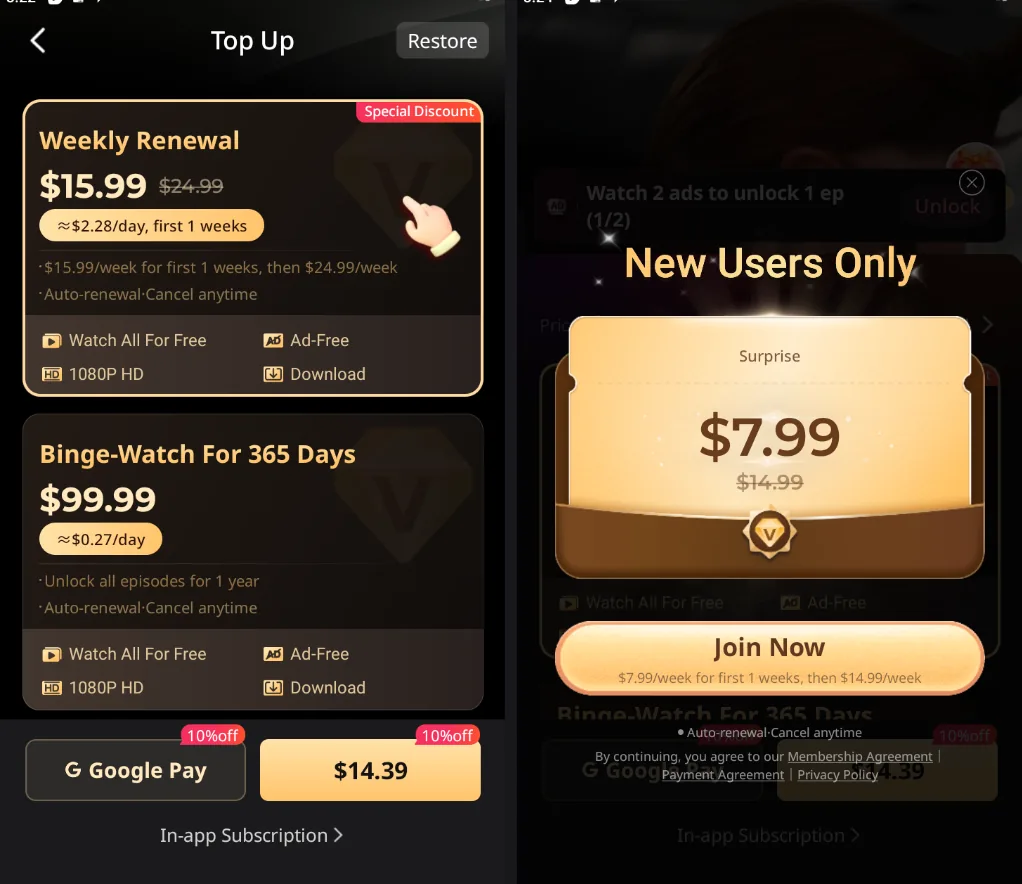
Add the renewal figures and the range is $7.99 to $24.99 for one weekly pass. No one in that screenshot is lying. The store is simply running three offers at once, aimed at three different people: the user who has been around a while, the user who is about to tap a Google Pay button, and the user who just installed the app.
StardustTV runs the same pattern one step further. Its payment screen offered a weekly pass at $17.99 with a 10% discount against a struck-through $19.99, while a coupon popup offered $13.19 for the same weekly pass labelled 40% off — on a one-hour countdown, with the base price never shown.
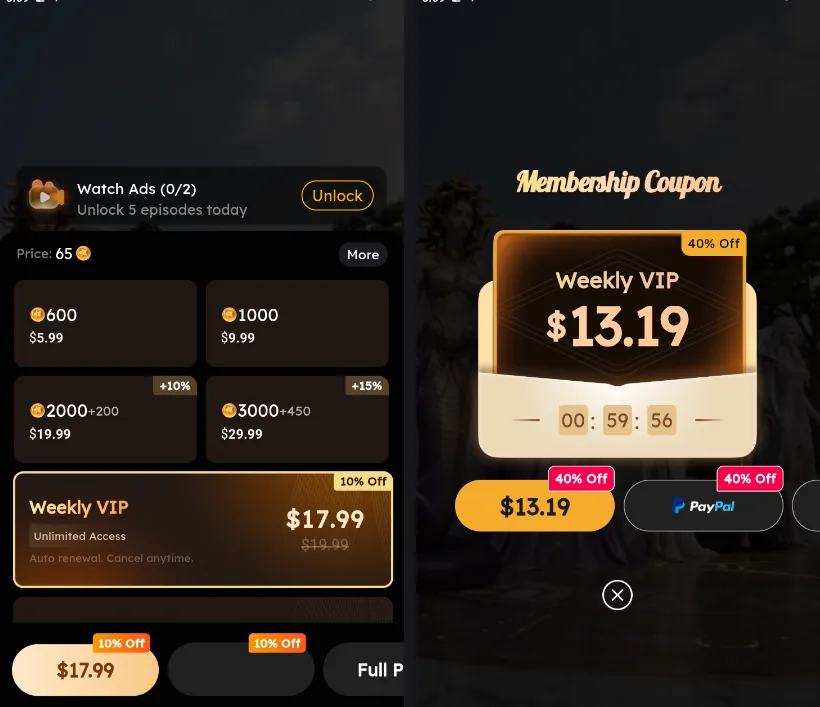
The arithmetic in that coupon does not work either: $13.19 is 40% off $21.99, not off the $19.99 the app shows elsewhere. The discount rate and the base price disagree, so “40% off” is not a statement about the actual price. A second app in our test set made the same mistake with a “51% off” popup whose base we could not establish at all.
This is worth dwelling on, because it means the price comparison most people perform is structurally broken. You cannot compare a site’s reported $30 to a popup offering $7.99 and conclude that the site was wrong.
Reason one: the day and the account
The offers above expire. Nearly all of them carried a countdown — usually 24 hours, occasionally one hour — which is a clear statement that the price is temporary by design.
On a ReelShort account we tracked over two consecutive days, the same weekly plan behaved like this:
Day one: $1.99 for the first week, labelled 67% off, renewing at $5.99/week.
Day two: $15.99 for the first week, labelled 21% off, renewing at $19.99/week. The $1.99 tier was no longer on the page at all.
Two facts matter here. The discount percentage is not derived from a real base price — 67% off and 21% off on consecutive days cannot both describe the same underlying rate. And the cheap tier was withdrawn, not sold out, so “while stocks last” is not the explanation.
A screenshot of an introductory offer is evidence the offer exists, not evidence you will be offered it. On the apps we tested, introductory pricing rotated by account as well as by day, and the better offers were labelled for new users only.
Reason two: your region, not your account
This is the one that catches people who think they have controlled the variable.
DramaBox priced itself by the country our network traffic exited from. On the same device, with the same account, changing only the exit node switched the entire app from Japanese yen to US dollars. The app’s own store page confirmed the mechanism in its help text, telling us to restart the app if prices looked stale. Both currency screens are recorded in our DramaBox review.
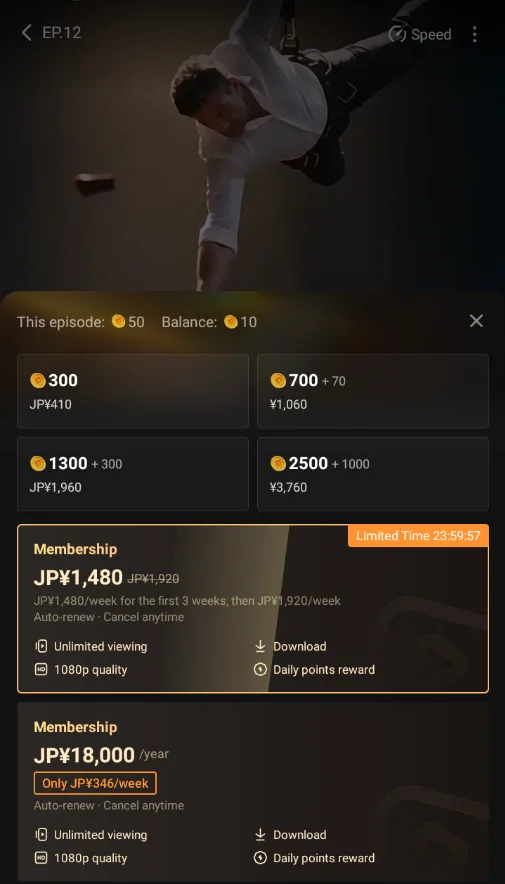
If you use a VPN, or you travel, or your traffic takes a different route, your price can change without you doing anything. Any comparison between two people is therefore also a comparison between two network routes, and most published prices do not record which route produced them.
ReelShort behaved the same way on our tests, though less completely.
Reason three: the screen you opened it from
The last mechanism is the quietest and probably affects the most people.
ReelShort’s store page showed coin packs starting around $9.99. Opening a locked episode instead revealed the same store offering a $4.99 starter pack that did not appear on the main store screen.
A user buying from the store page pays a higher price per coin than a user who happened to open a locked episode first. Nothing is concealed — the cheaper option simply requires knowing it exists. We found the same hidden smaller tiers on more than one app.
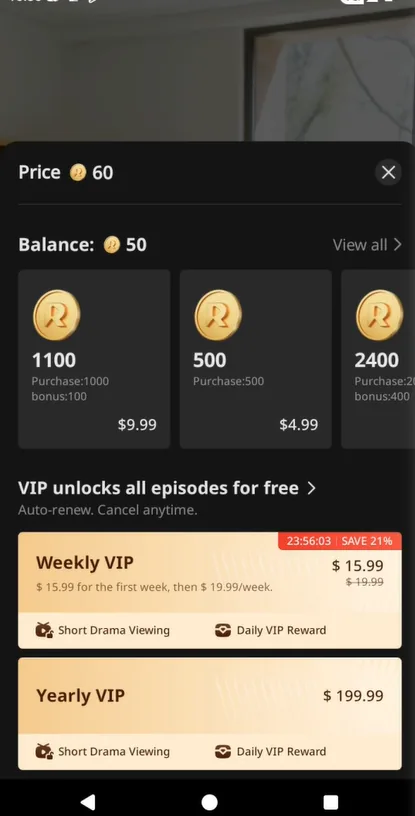
There is a fourth reason, specific to the largest app, and it explains why people comparing two ReelShort prices find a gap of several times rather than a few dollars. ReelShort runs two separate checkouts, and they do not agree.
The weekly plan priced at $1.99–$5.99 for the first week through Google Play in-app. The same plan on the app’s own website checkout came to $11.87 for the first week and $20.51 per week after, tax included, on the same account.
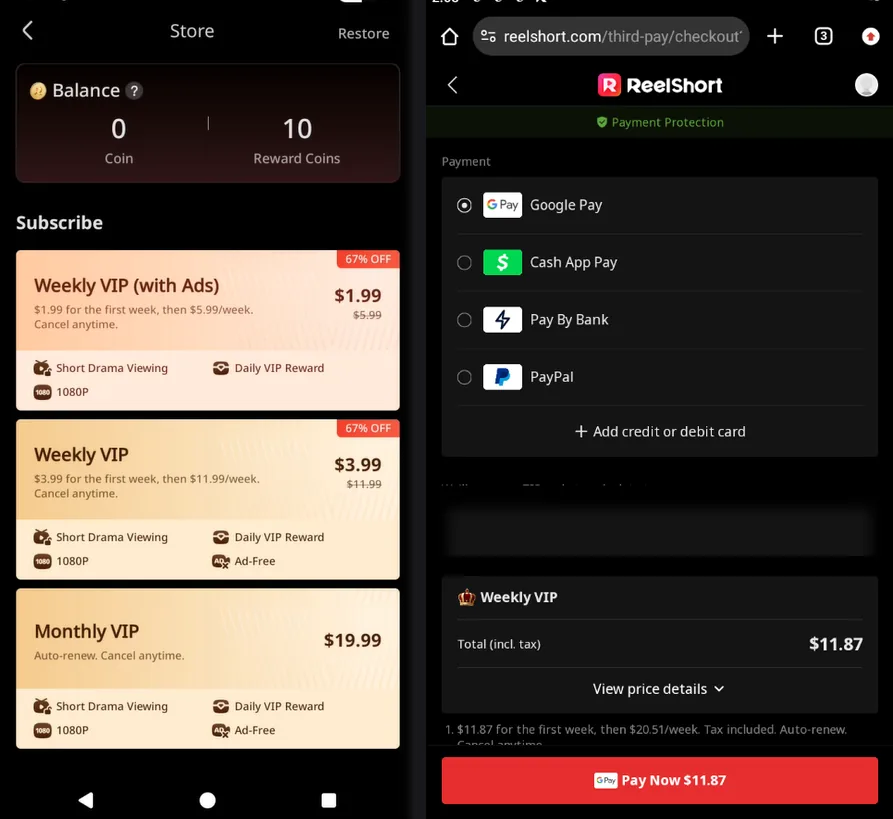
That matters beyond the price. A subscription bought through the website is not listed in your Play or App Store subscription settings, so the cancellation instructions in this site’s cancel guide do not reach it, and the store’s refund tooling does not cover it either.
Where the numbers actually disagree
We think the useful thing to publish is not our numbers but the conflicts, because a conflict survives the passage of time in a way a single price does not. Three we can document:
| What | One source | Our measurement |
|---|---|---|
| Single-episode coin cost | A competitor site states 18 coins | ReelShort charged 60 — a 3.3× difference |
| DramaBox annual plan | A competitor site states $49.99 | $119.99 in our checkout, with the app itself displaying “Only $2.31/week” |
| NetShort weekly pass | A competitor site states about $30/week | $15.99 intro, $24.99 renewal — the $30 figure matched nothing we could see |
We are not claiming the other sites are defrauding anyone. More likely they recorded a different day, a different account tier, or a different region and then wrote it down without a date. That is exactly the failure mode this article is about: a price without a date, a region and an account type is not information.
How to compare prices honestly
There is no shortcut, but there is a method. Ours has four steps:
Compare the renewal rate, never the intro rate. The intro rate is a promotion with a countdown; the renewal rate is what you pay for every week after. Across our apps, renewal weekly rates ranged from $5.99 to $24.99 — a range four times wider than the intro prices on offer.
Compare per-episode cost, not pack price. Divide the pack price by the coins you actually receive including bonuses. This is where ranking inverts: DramaBox’s entry pack is $2.99 against ReelShort’s $4.99, but ReelShort’s large pack is the cheapest per coin of anything we sold.
Compare on the same day, from the same route. A cross-day comparison is invalid for these apps by construction.
Assume your number will differ from ours. Ours were recorded on specific dates, on Android, on two physical devices and one emulator. Treat them as measurements, not quotes.
And if you want the cheapest way to finish a specific series rather than the cheapest subscription overall, the maths is different again — per-episode coin prices in our tests ranged from 50 coins to 98, and the free episode allowance ranged from episode 7 to episode 11 before the paywall, depending on the series. Our stop-paying guide works through the arithmetic.
Limits of this analysis
- One platform, mostly Android, October 2026. Six apps tested on Android with US Google Play accounts, plus one payment taken on a physical phone. iOS pricing uses Apple’s billing and may not rotate identically.
- The rotation findings come from short observation windows. The ReelShort day-one/day-day pair is two days on one account. It matches the countdown mechanics visible in the apps, but we are not claiming to have characterised their rotation schedule.
- Competitor figures in the conflict table are as published, not verified. We have not tested those sites’ methodologies and are not accusing them of error — the point is that an undated, unattributed price cannot be checked.
- Region pricing was tested by changing the exit node, not by travelling. Other inputs — billing address, store account country, tax jurisdiction — may matter too and we did not isolate them.
- This is not an accusation of price manipulation. Every price described here is disclosed on a screen the user confirms. The design leans on urgency and entry-point discovery; that is a legal model, and the reason it works is that most people never see more than one number at a time.
When this guidance does not work for you
This article explains why prices disagree. It does not tell you which app is cheapest for you, and in several common situations it cannot:
- If you only intend to watch one series. The whole analysis is built on subscription and coin-pack prices. Finishing a single show is usually a coin problem, and the cheapest entry point and the cheapest way to finish were different apps in our testing.
- If you subscribe from iOS. Apple’s billing is a different system and we have not measured whether these offers rotate the same way there. Our iOS knowledge in this project comes from Apple’s official documentation, not from testing.
- If you are outside the US. We measured on US routes, which is the most crowded case. In other regions the entry price may be lower and the rotation may behave differently, and we have no data on that.
- If you are reading this months from now. Every figure here is a snapshot from October 2026 and the mechanism will outlive it. Check the live screen, not this page.
- If your issue is being charged after cancelling. None of this explains that, and it is a different problem — see the renewal loop for the billing mechanics, and expect to deal with the store, not the app.
Frequently asked questions
Why does ReelShort cost different amounts on different days?
Because the intro rate is not a price — it is a rotating offer. On our account the same weekly plan showed $1.99 labelled 67% off on one day and $15.99 labelled 21% off the next, each with a 24-hour countdown. The renewal rate is a separate number again, and the plan list itself changes: the $1.99 tier disappeared the following day rather than being sold out.
Why does the price change when I change my VPN?
Two of the apps we tested price by the country your traffic exits from, not by your app store account. DramaBox rendered entirely in Japanese yen while the exit node was in Japan, and in US dollars on the same device and same account after switching to a US node. ReelShort also moved between prices when the route changed. If you use a VPN, your country of payment is not fixed.
Which short drama app is actually the cheapest?
There is no single answer, which is the honest version of this article. On the numbers we measured in October 2026, the cheapest weekly figure anywhere was a StardustTV coupon at $13.19 — but its per-episode coin price was 65, the highest of the apps that publish one, and finishing a series through ads took ten ads for five episodes. The cheapest entry point and the cheapest way to finish a series were different apps.
So why should I trust the prices on this site?
You should not treat them as current either — treat them as dated measurements, which is how we label them. Every price here carries the date and device it was recorded on, and we publish the contradictory readings rather than the prettiest one. The prices on your screen at the moment of purchase are the only ones that apply to you.
Can I get the same introductory price a review shows?
Not reliably. Introductory offers in these apps rotate by account as well as by day, and the ones we saw were labelled "New Users Only". A screenshot of someone else at $1.99 is evidence the offer exists, not evidence you will be offered it.